
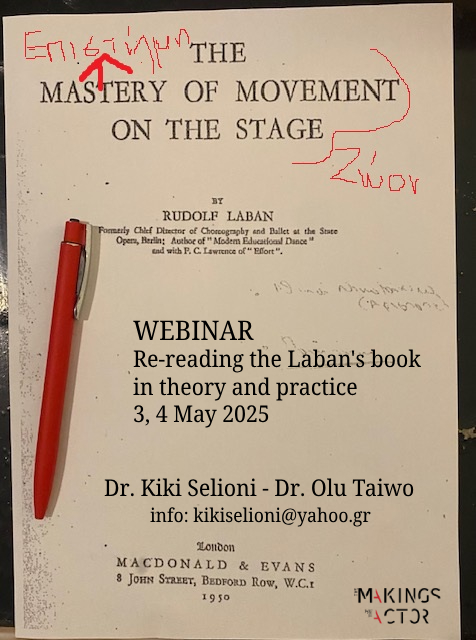
Webinar: Re-reading Laban’s Book
Stephen Halliwell in his introduction about aesthetic concepts in Ancient Greek philosophy writes:
The lack of any one-to-one correspondence between modern uses of ‘aesthetic(s)’ and the vocabulary of Classical Greek is a complex matter. But complexity is not all the result, as sometimes alleged, of an ancient conceptual deficit; it arises just as much from the uncertainties and obscurities which attach to the modern terminology itself. Aesthetic Value in Classical Antiquity Edited by Ineke Sluiter Ralph M. Rosen chapter two AMOUSIA: LIVING WITHOUT THE MUSES p: 16.
Stephen Halliwell, realizing the thorny problem of translating the concepts in Ancient Greek philosophy. Τhis was also the case with the concept of mimesis as we find it in Aristotelian Poetics usually translated as imitation or representation. Speaking of Poetics, however, the essential point is that it is not a philosophical text as per se, but a scientific treatise on the fundamental principles of the science of theatre, i.e. mimesis is poetic episteme as a constructive capacity based on logic with moral and political dimensions. Moreover, someone has to deal with the difficulty of understanding the Greek vocabulary in an experiential somatic experience. The notions as episteme and its relation with knowing and understanding and the idea of skills as they proposed by Aristotle are issues which still in question today.
Aristotle’s broad conception of philosophy is simply that of knowledge (ἐπιστήµη) of the truth,6 and he sometimes speaks of knowledge as including not only theoretical sciences but applied skills (τέχναι).7 It is in this sense that Aristotle, at the beginning of the Metaphysics, contrasts knowledge and skill with mere experience: knowledge and skill involve the grasp of universals generated from the experience of similar particulars (981a5–6). Grasp of the universal enables the person with knowledge or skill to understand, with respect to her field, the reasons why things are the way they are or why tasks ought to be done in a certain way, and consequently allows her to teach the same to others (981a29–b10). Since Aristotle thinks that poetry is a skill (Po. 1450b20), he must think that the poet grasps a certain subject. John Armstrong ARISTOTLE ON THE PHILOSOPHICAL NATURE OF POETRY Classical Quarterly 48 (ii) 447–455 (1998)p:
Skills and capacity are key terms in Aristotle Poetics but somehow the concept of skill does not seem to fit the philosophy and thinking of the part of the academic community in acting while at the same time actors need to have special skills as part of their work (films and action series). On the other hand some practical artists are reluctant to theories and discussions as something that does not concern their practical development. There seems to be a confusion about what is a skill and what is episteme, what is theory and what is the relationship with application. If we do not clarify the field in which we are discussing and if we do not understand the words in their meaning and their relation to practice in order to communicate deeply, we will continue the debate and controversy. We need to revisit the concepts of skill and competence.
Someone who is ready to learn housebuilding is in capacity a housebuilder, but is not in the relevant sense able to build a house. This person is able to learn to build a house. Understanding this person’s capacity requires understanding not one but two energeiai: learning and housebuilding. Aristotle’s view about capacities seems to me to be correct. I cannot find anything further to saying in its favour. But I cannot see how anyone could grasp the the concept of a capacity without knowing what it is a capacity for. Jonathan Beere Doing and Being: An interpretation of Aristotle’s Metaphysics Theta chapter 13 The priority of energeia Theta 8, October 2009. For more info click here.
It is well known that Laban’s work is influenced by ancient Greek thought. As Dr Kiki Selioni writes, Laban is in agreement with Aristotle and, in particular, that he puts Aristotle’s Poetics into practice based on the exegesis of contemporary Greek philosopher Stelios Ramfos in Mimesis versus Form (1991 and revised edition 2019).
While Aristotle was conceiving and formulating the quintessence of the art of poetry, he was at the same time delivering to humanity a text that will always move it because it will confront it with its weaknesses. Giving a voice to Poetics itself means recognizing it as a field of criteria and not as a source of information and opinions, approaching it as an Archimedian support that allows us, together with the text, to read ourselves. This is the task of Mimesis vs. Form (Ramfos about his book 12/4/19).
It is also known that Laban was forced to translate the terms into English, which he admits he does not know very well, and this naturally creates problems, especially in the transfer of complex concepts.
In this webinar we will analyze the concepts as they appear in his book The Mastery of Movement on the Stage in 1950and give the correct translation and explanation according to the Greek language. We will also demonstrate their practical application.
Facilitated by Dr. Kiki Selioni – Dr. Olu Taiwo
On the 3rd and 4th of May 2024, 14:00 – 19:00 EEST, 07:00 – 12:00 ET
Location: central Athens
Language: English
Fee for 10 hours: 90 euros
Student price: 45 euros
Online and in person
Info: kikiselioni@yahoo.gr themakingsoftheactor@gmail.com


